
How to Change Case in Excel: UPPER, LOWER, PROPER + a Shortcut
by Yaron Elharar ( @YaronElharar )
Updated · First version published
If you work with a lot of text in Excel, you have probably needed to change capitalization. Unlike Word, Excel has no Change Case button, and it has no built-in shortcut that toggles selected cells between uppercase, lowercase, and title case. Shift+F3, which changes case in Word, opens Insert Function in Excel instead.
Microsoft still recommends the UPPER, LOWER, and PROPER functions. Excel also has Flash Fill (Ctrl+E) as a native alternative. If you want an in-place keyboard shortcut, that comes from AnyCase, not from Excel itself. This page covers all three.
If the text is not in a sheet, or you only need to convert a snippet once, use the free case converter.
How To Change Case In Excel?
Using A Formula to Change Capitals in Excel
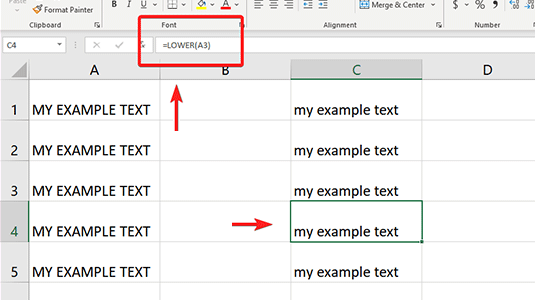
Excel can change case with these three functions:
- UPPER — converts text to uppercase
- LOWER — converts text to lowercase
- PROPER — capitalizes the first letter and letters after non-letter characters, and lowercases the rest
PROPER is not the same as editorial title case. It follows a mechanical rule, so names, acronyms, and headline-style capitalization can come out wrong (for example, "mcdonald" becomes "Mcdonald", and "USA" can become "Usa").
Microsoft’s current recommended procedure uses a temporary column, then paste values over the original:
- Create a temporary column next to the text you want to change.
- In the first empty cell, enter a formula such as =LOWER(A2), =UPPER(A2), or =PROPER(A2), using the cell you want to convert.
- Fill the formula down the rest of the column.
- Copy the results, then paste them as Values over the original column.
- Delete the temporary column.
That works, but it is still several steps every time you need a case change, and the result is not converted in the original cells until you paste values.
Using Flash Fill (Ctrl+E)
Flash Fill is built into Excel. It is not an in-place case toggle — the corrected text still goes in another column — but it is a useful native option when the first example is enough for Excel to infer the pattern.
- In an adjacent column, type the first value with the capitalization you want.
- Press Ctrl+E, or start typing the second corrected value and accept Flash Fill when Excel suggests the rest.
- If you need the result in the original column, copy the Flash Fill column and paste it as Values over the original, then delete the helper column.
A one-off conversion or an in-place Windows shortcut
One-off paste, not an in-place Excel change: use the free case converter. That page does not rewrite Excel cells. If you change case often in Excel or other Windows programs, download AnyCase for Windows and convert selected text where you already typed it.
Using AnyCase Third-Party Keyboard Shortcuts
Excel itself does not provide Win+Alt shortcuts for changing case. The shortcuts below belong to AnyCase, a Windows utility that converts selected text in place in Excel and many other programs. Install AnyCase first; without it, those key combinations do nothing in Excel.
The free version is unlimited to use, with a short delay between conversions. AnyCase Pro is $24 per year and removes that delay. It includes three stations.
To enable in-place shortcuts in Excel:
- Download AnyCase.
- Install it as you would any other Windows program.
- Select the cells or text you want to convert, then use one of the shortcuts below.
AnyCase shortcuts that work in Excel
These are the default AnyCase shortcuts. You can change them in AnyCase settings.
| Windows shortcut | Action |
|---|---|
| Win+Alt+L | Convert selection to lowercase |
| Win+Alt+U | Convert selection to UPPERCASE |
| Win+Alt+T | Convert selection to Title Case |
| Win+Alt+S | Convert selection to Sentence case |
| Win+Alt+A | Convert selection to AlTeRnAtInG CaPs |
| Win+Alt+O | Open the main AnyCase window |
Shortcuts require the free AnyCase App.
Final Thoughts
To change case in Excel you have three practical options: UPPER, LOWER, and PROPER in a helper column; Flash Fill with Ctrl+E; or AnyCase if you want a true in-place Windows shortcut. Formulas and Flash Fill stay inside Excel. The shortcut method is AnyCase, not a hidden Excel command. For a one-off paste outside Excel, use the free case converter.
In a later article we cover How To Remove Spaces In Excel Without A Formula.