
How To Change The Selected Text Case In DaVinci Resolve Easily
by Yaron Elharar ( @YaronElharar )
Updated · First version published
DaVinci Resolve 21.1, Blackmagic’s current major update, has built-in Font Case controls for standard Text titles and subtitle tracks, so you may not need an external utility. For Text+ titles in Fusion, where the same Font Case control may not be available, you can attach a Fusion expression such as string.upper(...) or string.lower(...) to force an entire text value to uppercase or lowercase. That expression changes the rendered Text+ value rather than acting as a universal “change selected text case” command, and Lua-based case conversion may have limitations with some non-ASCII characters.
What Is DaVinci Resolve?
DaVinci Resolve, developed by Blackmagic Design, is a video editor that also covers color grading, visual effects, motion graphics, and audio post-production in one app. Editors use the Edit page for titles and captions, Fusion for Text+ and compositing, and a dedicated subtitle track for captions. This article is scoped to Resolve 21.1 on Windows.
Built-in Ways to Change the Case of Text in DaVinci Resolve Fields
Resolve has native case controls. Which one you use depends on the text tool:
- Basic Text title: Inspector Font Case — Mixed Case, All Caps, All Lowercase, Small Caps, Title Caps.
- Subtitle track: Inspector → Track → Font Case (added in Resolve 18.6) — All Caps, All Lowercase, Small Caps, Title Caps.
- Text+ / Fusion: when Font Case is unavailable, a Fusion expression can transform the whole string.
Resolve 21 also expanded the native text system — a new font browser, spell checking for text elements, and improved Text+ / MultiText font support. Those are editing improvements, not extra case-conversion commands.
Basic Text titles: Font Case in the Inspector
Ordinary Text titles expose a Font Case control. Blackmagic documents Mixed Case, All Caps, All Lowercase, Small Caps, and Title Caps. Use this before opening Fusion or installing anything else.
- On the Edit page, add or select a Text title on the timeline.
- Open the Inspector.
- Find Font Case and choose Mixed Case, All Caps, All Lowercase, Small Caps, or Title Caps.
- The title updates to that case.
Subtitle tracks: Font Case since Resolve 18.6
Captions and subtitles do not need a Fusion expression for ordinary case changes. Since Resolve 18.6, the Subtitle Inspector includes Font Case: All Caps, All Lowercase, Small Caps, and Title Caps.
- Select the subtitle clip on the subtitle track.
- Open the Inspector and go to Track.
- Set Font Case to All Caps, All Lowercase, Small Caps, or Title Caps.
Text+ in Fusion: an expression for the whole string
Text+ is the Fusion title tool. Font Case may not be available there the way it is on a basic Text title. In that case you can attach an expression to the Text+ control. Fusion still lets you right-click a control and choose Expression from the contextual menu. The usual Lua helpers are string.upper(...) and string.lower(...).
- Open the Fusion page for the Text+ title.
- Select the Text+ node and find the Styled Text control.
- Right-click that Fusion control and choose Expression.
- Replace the default expression with string.upper(...) or string.lower(...) so the whole string is forced to that case. For a literal value, use string.upper("Your Text"). To wrap the existing control, use string.upper(Text).
- The Text+ result updates to that case.
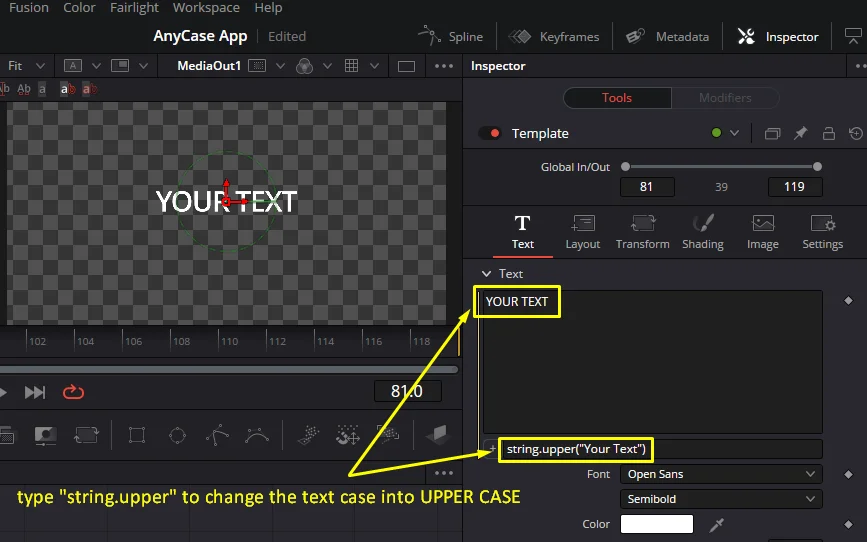
This is not a general-purpose “change selected text case” command. The expression changes the result produced by the Text+ control — generally the whole string — rather than selecting arbitrary characters and permanently rewriting them in place. Forum reports (not an official Blackmagic spec) also say Lua string.upper and string.lower can fail to convert some UTF-8 or accented characters.
How To Change Text Case In DaVinci Resolve Directly In-Place
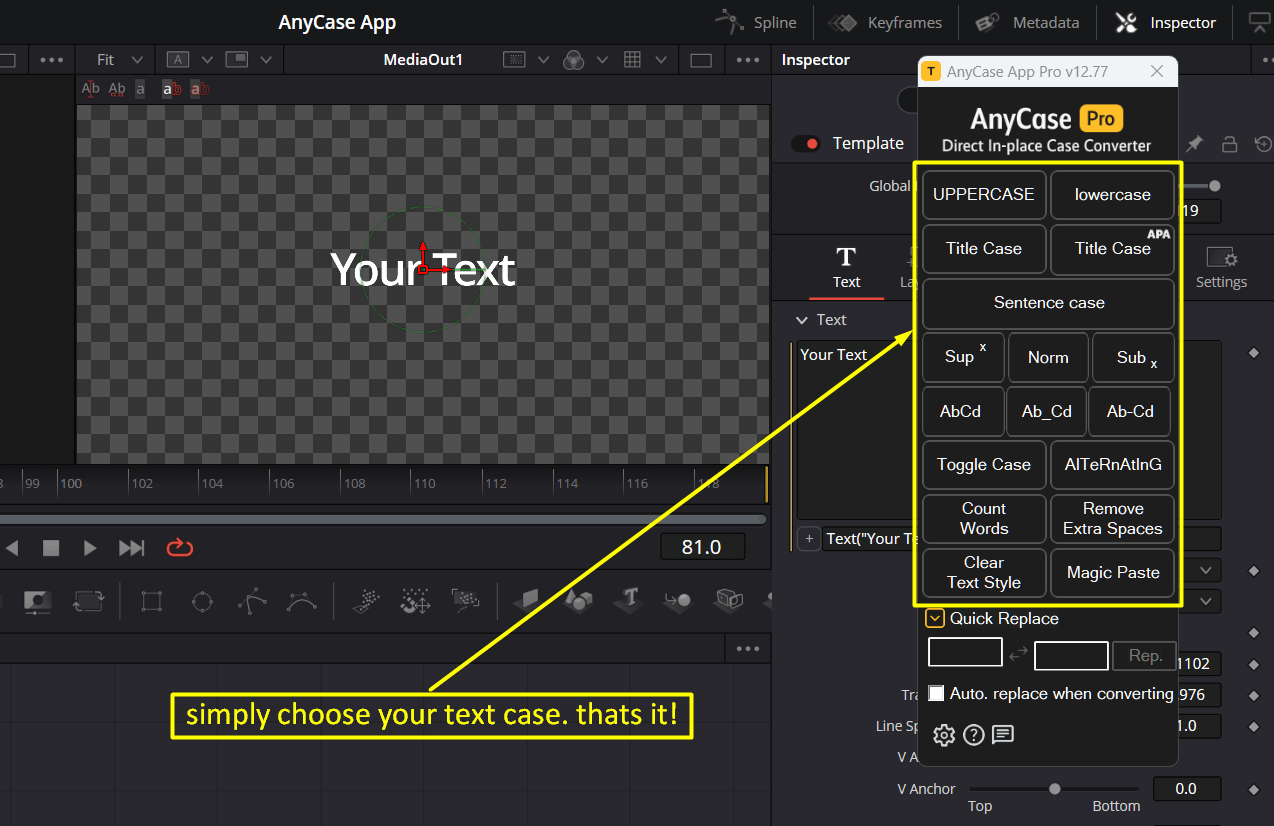
Use AnyCase when you are in an editable Resolve field that does not expose Font Case, or when you want the same in-place Windows shortcut in Resolve and countless other Windows programs. AnyCase is a Windows 11, 10, 8.1, and 8 utility. It is not a DaVinci Resolve feature, and it is not a multi-platform app.
The free version is unlimited to use, with a short delay between conversions. AnyCase Pro is $24 per year and removes that delay. It includes three stations.
- Download AnyCase.
- Install it as you would any other Windows program.
- In DaVinci Resolve, select the text in an editable field.
- Hold Shift, then right-click the selection. Choose the case you want from the AnyCase conversion menu. Ordinary right-click alone opens the usual Resolve menu, not the AnyCase conversions. You can also pick a case from the AnyCase window.
If you only need to convert a snippet once, use the free case converter. That page pastes converted text. It does not rewrite titles or captions in the open Resolve project.
AnyCase shortcuts that work in DaVinci Resolve
These are the default AnyCase shortcuts. You can change them in AnyCase settings. They are not DaVinci Resolve shortcuts. Install AnyCase first; without it, those combinations do nothing in Resolve. Win+Alt+U is UPPERCASE, Win+Alt+L is lowercase, Win+Alt+T is Title Case, and Win+Alt+S is Sentence case.
| Windows shortcut | Action |
|---|---|
| Win+Alt+L | Convert selection to lowercase |
| Win+Alt+U | Convert selection to UPPERCASE |
| Win+Alt+T | Convert selection to Title Case |
| Win+Alt+S | Convert selection to Sentence case |
| Win+Alt+A | Convert selection to AlTeRnAtInG CaPs |
| Win+Alt+O | Open the main AnyCase window |
Shortcuts require the free AnyCase App.
Final Thoughts
Start with Resolve’s own Font Case on a basic Text title or, since 18.6, on a subtitle track. Use a Fusion expression on Text+ only when Font Case is not available, and remember it rewrites the whole rendered string, with possible Unicode limits in Lua. If you want the same in-place Windows shortcut in other Resolve fields and countless Windows programs, that comes from AnyCase. For a one-off paste, use the free case converter.