
How To Change The Selected Text Case In CapCut on Windows
by Yaron Elharar ( @YaronElharar )
Updated · First version published
CapCut for Windows can change the case of selected text without a third-party app. Select a text layer, then use Text → Basic → Case. The Case row shows three native options: TT (uppercase), tt (lowercase), and Tt (title case). That is what CapCut’s PC UI shows.
What Is CapCut?
CapCut is ByteDance’s video editor — the same company behind TikTok. It is available on desktop, mobile, and the web, with free features and paid/premium options. This article is about CapCut on Windows. You can cut, trim, add effects and transitions, use a large audio library, and add text, stickers, and animations. Desktop CapCut also includes auto captions and speech-to-text for turning spoken audio into on-screen captions.
Built-in Ways to Change the Case of Text in CapCut Fields
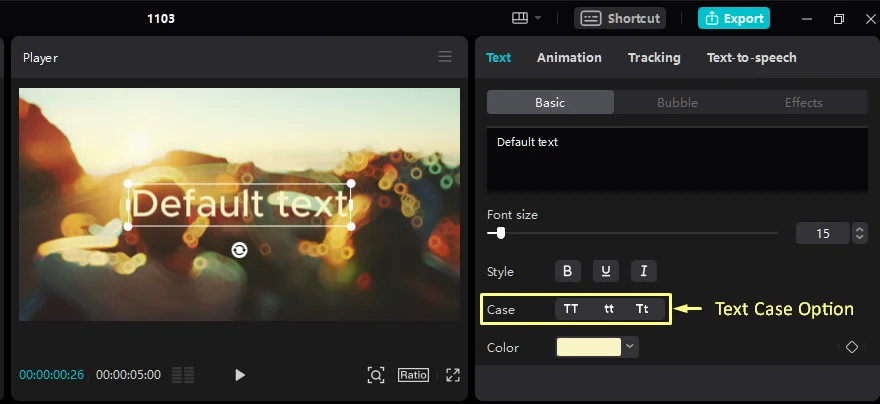
CapCut’s Windows editor has a built-in Case control. After you select a text layer, open the Text inspector and go to Text → Basic → Case. You get three buttons:
- Select the text layer on the timeline, or create a new text clip.
- Open the Text inspector. Under Basic, find the Case row.
- Click TT for UPPERCASE, tt for lowercase, or Tt for Title Case.
- The chosen case applies to the selected text.
Those three native options are still what CapCut’s PC UI shows. There is no built-in sentence case, kebab-case, snake_case, or camelCase on that Case row.
If the text is not already in a CapCut text layer, or you only need to convert a snippet once, use the free case converter. That page pastes converted text. It does not rewrite the open CapCut project.
When CapCut’s Case row is not enough
Uppercase, lowercase, and title case are already on that Case row. For sentence case, kebab-case, snake_case, or camelCase, AnyCase converts the selection in place. It is a Windows utility, not a CapCut feature.
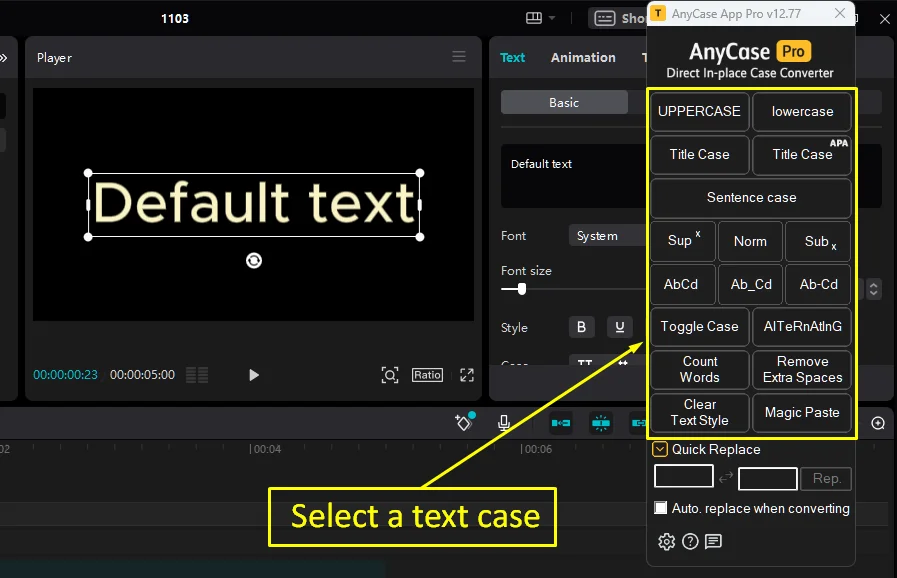
- Download AnyCase.
- Install it as you would any other Windows program, and leave it open.
- In CapCut, select the text whose case you want to change.
- Hold Shift, then right-click the selection and choose the case. Ordinary right-click alone opens the usual CapCut menu.
Final thoughts
For uppercase, lowercase, or title case, use CapCut’s own Case row: Text → Basic → Case, with TT, tt, and Tt. AnyCase is only for cases that row does not include. For a one-off paste, use the free case converter.